

Consumer Trends And Preferences In Poultry Products

Poultry products have long been a cornerstone of global diets, but in recent years the way consumers choose, purchase, and consume them has been shifting. Evolving preferences, health considerations, sustainability concerns, and technological innovations are reshaping demand across markets. Understanding these dynamics is critical for producers, retailers, and policymakers aiming to align supply with changing consumer behavior.

Health and Nutrition as Key Drivers

Health consciousness has become one of the most powerful forces shaping consumer demand in the poultry industry. Increasingly, buyers are drawn to poultry—especially chicken—because it is widely perceived as a lean, high-quality protein that contains less saturated fat than red meat. This aligns with popular dietary patterns such as high-protein, low-carb, and weight management plans, making poultry a flexible option across diverse lifestyles.

At the same time, consumers are looking more closely at how poultry is raised and processed. The demand for products labeled antibiotic-free, hormone-free, or organic has surged, reflecting concerns about food safety, long-term health effects, and transparency in farming practices. According to recent market analyses, shoppers are also showing growing interest in “functional” poultry products, such as chicken enriched with omega-3 fatty acids or raised with specialized feed to improve nutritional content. These preferences indicate that health is no longer defined only by calorie counts or fat levels, but by the overall integrity of the food chain. In this sense, poultry producers who emphasize clean, natural, and responsibly raised products are aligning with a major consumer priority.

Shift Toward Convenience

Busy lifestyles and urbanization are driving demand for poultry products that save time and effort. Ready-to-cook marinated chicken, frozen nuggets, and pre-cooked deli meats are increasingly popular in both developed and emerging markets. Packaging innovations - such as resealable packs and portion-controlled servings - enhance convenience and reduce food waste, aligning with consumer expectations.

Consumer Trends in Poultry
Explore how health, convenience, sustainability, and transparency are influencing consumer choices in poultry products.

Ethical and Sustainable Choices

The way consumers purchase poultry is also undergoing rapid transformation as digital shopping channels gain traction. Online grocery platforms, subscription services, and food delivery apps have made it easier than ever to buy fresh or processed poultry products without setting foot in a store. This trend accelerated dramatically during the COVID-19 pandemic, when safety and convenience became central considerations, but it has remained strong even as in-person shopping rebounded.

Younger generations in particular are comfortable purchasing fresh meat online, with surveys showing that nearly half of U.S. consumers in the 18–34 age group have bought poultry and other fresh proteins through digital platforms in recent months. E-commerce offers added benefits such as greater traceability, the ability to compare brands, and access to niche or specialty poultry products that may not be available in local supermarkets. Direct-to-consumer farm sales, meal kit services, and customized poultry subscription boxes further illustrate how digitalization is reshaping not just where people buy their food, but how they perceive freshness, quality, and trust in suppliers. For producers and retailers, embracing digital sales channels is no longer optional but a strategic necessity to meet evolving consumer expectations.

Price Sensitivity and Value for Money

Affordability continues to play a central role in poultry consumption. During periods of economic uncertainty, poultry often becomes the preferred protein choice as it is generally cheaper than beef, seafood, or plant-based alternatives. Retailers and producers must balance quality with cost to maintain consumer loyalty.

The Impact of Alternative Proteins

While plant-based and lab-grown proteins are gaining traction, poultry remains resilient due to its taste, affordability, and cultural importance in many regions. However, some consumers view poultry and plant-based proteins as complementary rather than competing choices, leading to diversified household protein purchases.

Digitalization and E-commerce Growth

Online grocery platforms and food delivery apps are changing how consumers buy poultry. From customized subscription boxes to direct-to-consumer farm sales, digital channels provide greater access and traceability. This trend has accelerated post-pandemic, with convenience and safety cited as major benefits.

A transforming global industry

The poultry sector has seen rapid growth and structural changes, with increased focus on efficiency, scalability, and sustainability.

Today, it plays a key role in meeting global protein demand.
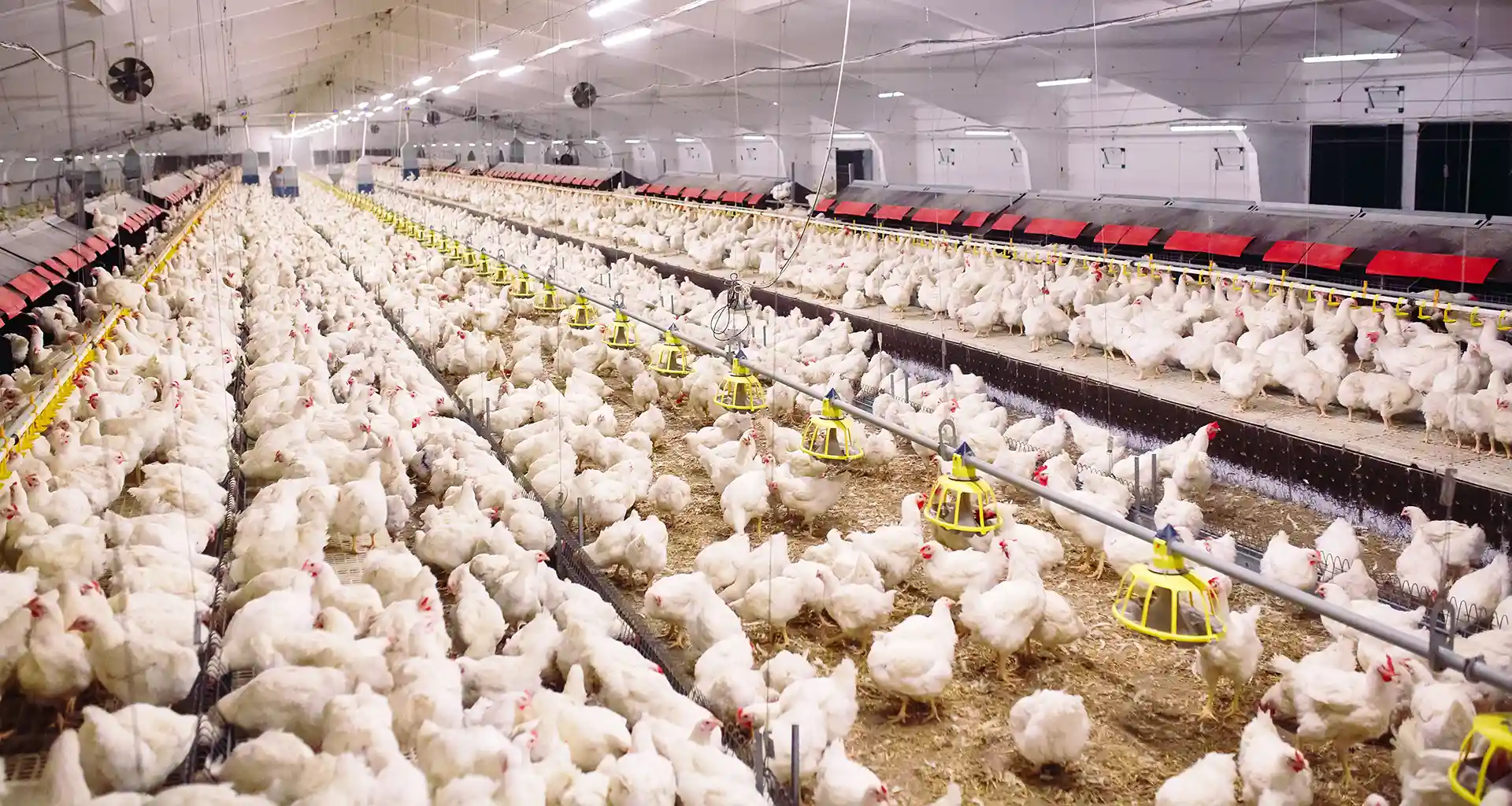
Discover how poultry production has evolved

Consistent And Reliable Feed Supply In Poultry Production
Learn how continuous monitoring helps producers identify developing production challenges through changes in water consumption, growth performance and other key production indicators.

Feed supply involves the delivery of raw materials, ingredients, or mixed feed to production sites like factories, plants, or animal farming operations. Maintaining a steady and dependable supply of feed is essential for the efficient functioning of any production site and for the well-being of animals in farming contexts.

Incorporating Capacitive Sensors into Feed Supply Management

Enhancing the feed supply chain’s effectiveness can be achieved by integrating capacitive sensors. Capacitive sensors are electronic devices that measure the capacity or amount of electrical charge stored in a material. They work by detecting changes in capacitance, which is the ability of a material to store an electrical charge.

Capacitive sensors have a wide range of applications in managing feed supplies. For instance, they are effective in gauging the quantity of raw materials in storage facilities like bins, silos, or tanks. This monitoring helps in averting material shortages and guarantees uninterrupted production due to sufficient raw material or compound feed availability.

Monitoring The Flow Rate

Capacitive sensors can also be used to monitor the flow rate of raw materials being transported through pipes or conveyor belts. This can help to optimize the rate at which materials are supplied to the production process, ensuring that there is neither an excess nor a deficiency of raw materials.

Overall, the use of capacitive sensors in the feed supply process can help to improve efficiency, reduce costs, and prevent disruptions in production. They offer a reliable and cost-effective means of monitoring and controlling the flow of raw materials, ensuring that production can be maintained at optimal levels.

Consequences of Insufficient Climate Monitoring in Poultry Houses
Learn how continuous monitoring helps producers identify developing production challenges through changes in water consumption, growth performance and other key production indicators.

Environmental stability is essential for maintaining health, welfare, and uniform growth in poultry production. When temperature, air quality, and airflow are not monitored continuously, deviations often develop gradually and remain unnoticed until they have already affected flock performance. These changes influence bird behavior and overall productivity.

Temperature Drift and Uneven Growth

Temperature variation is one of the earliest consequences of inadequate monitoring. Birds respond by clustering in warmer areas and avoiding cooler zones, which alters feed access and increases competition. Over time, these behavioral adjustments lead to measurable differences in body weight and feed conversion. Because temperature drift develops slowly, it is rarely detected through periodic checks alone.

Humidity Rise and Litter Stagnation

Humidity increases rapidly when ventilation is reduced, especially during nighttime or cold weather. Without monitoring, these fluctuations remain unnoticed until litter becomes wet or compacted. Elevated humidity accelerates ammonia release and reduces resting comfort. Birds avoid wet areas, concentrating stocking density in drier zones and reinforcing uneven growth patterns.

Air Quality Decline: CO₂ and Ammonia Accumulation

CO₂ and ammonia are invisible and cannot be reliably assessed through sensory cues. When ventilation weakens, CO₂ accumulates quickly, reducing bird activity and suppressing feed intake. Ammonia rises as litter moisture increases, irritating the respiratory tract and compromising immune defenses. Manual checks detect air quality problems too late, because CO₂ and ammonia can reach harmful levels long before they become noticeable to humans.

Ammonia levels have a direct impact on animal welfare, growth, and feed efficiency in poultry production. Explore how accurate ammonia measurement can help you maintain optimal conditions and improve overall results.

LoRa Sensors
Learn how continuous monitoring helps producers identify developing production challenges through changes in water consumption, growth performance and other key production indicators.

Our LoRa water meter and advanced LoRa sensors provide reliable, long-range data transmission for smart metering and environmental monitoring. Built on LoRaWAN technology, these solutions are ideal for utilities, facility managers, and industrial applications that require low power consumption and secure wireless communication.

LoRa water meter for remote reading

A LoRa water meter enables accurate water consumption monitoring without manual readings. Using long-range wireless technology, the lora water meter transmits data over long distances, making it suitable for agriculture and industrial water management.

LoRa sensors for environmental data

Our portfolio of lora sensors includes solutions for air quality, temperature, and CO₂ monitoring. Devices such as a lorawan CO2 sensor help track indoor air quality, while a lora temperature sensor ensures precise temperature monitoring in buildings, warehouses, and outdoor installations.

LoRa temperature sensor – accurate and energy efficient

A lora temperature sensor is designed for long battery life and stable performance.

Why choose LoRaWAN solutions?

  • Reliable lora water meter data transmission
  • Wide range of lora sensors for smart monitoring
  • Easy integration with a lorawan CO2 sensor
  • Accurate measurements from a lora temperature sensor
  • Scalable networks with the right lora gateway kaufen option

With our LoRaWAN-based solutions, you can build a future-proof monitoring system using lora water meter technology and professional lora sensoren for real-time data and smarter decision-making.

Selected Sensors

No items found.

Documents

English
Leaflet
Climate Brochure
English
Leaflet
Capacitive Brochure

Join our newsletter

Stay ahead in livestock production.

Join our newsletter and get industry insights, expert perspectives, and practical strategies for optimizing performance and efficiency.